Schengen Visa Fee 2026: EUR 90, Who Pays Less and What Visa Centres Add
Updated Sat, 14 November 2026
Add up the visa fees for your group →If your passport is not on the EU’s visa-free list, you need a Schengen visa (type C) for short trips of up to 90 days in any 180 to the 29 Schengen countries. The fee is set by EU law, so it is the same whichever Schengen country you apply to. What changes from one consulate to the next is the service charge on top.
How much the visa costs in 2026
The fees come from article 16 of the EU Visa Code, as amended by Commission Delegated Regulation (EU) 2024/1415. They have applied since 11 June 2024, when they rose from EUR 80 and EUR 40.
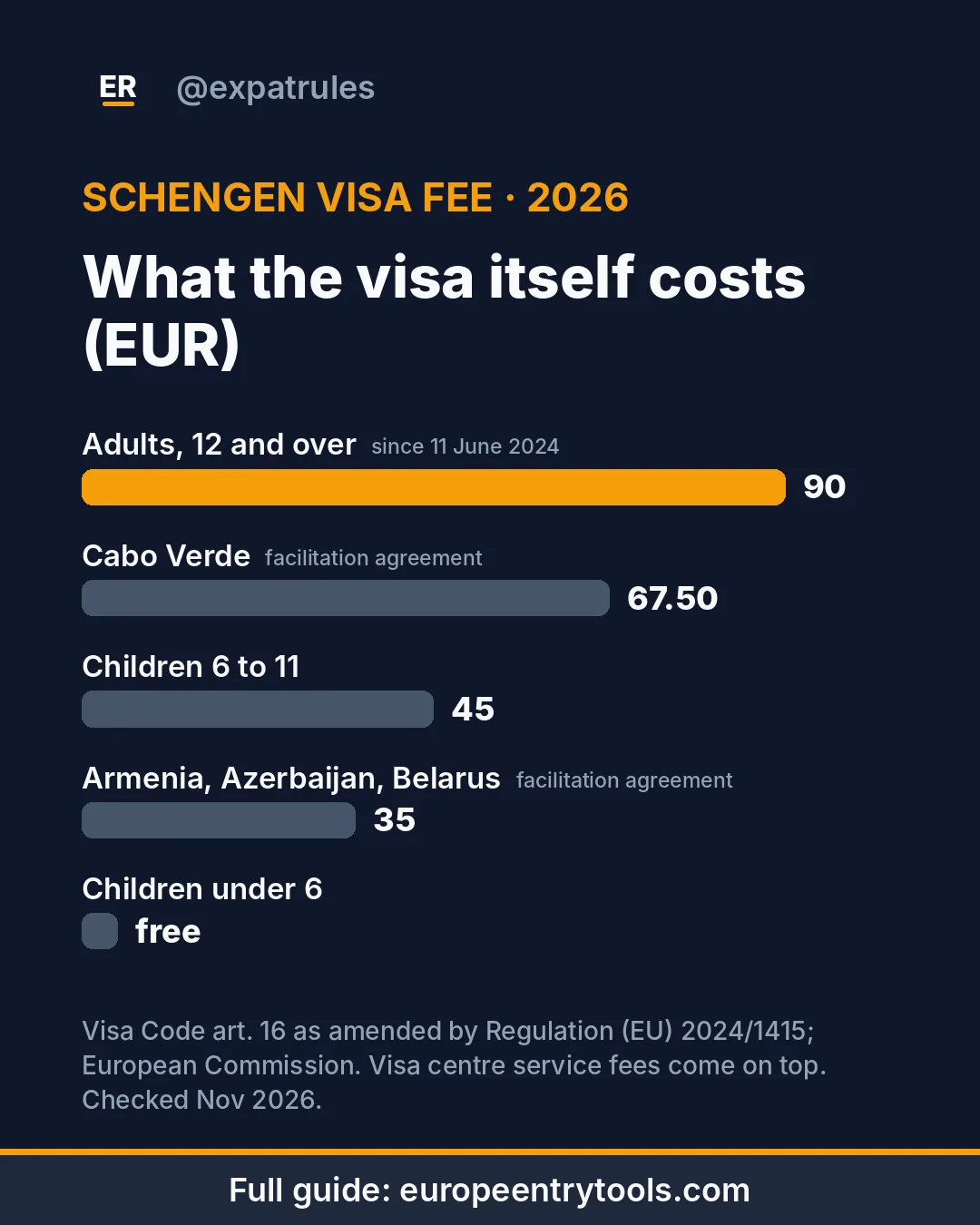
| Applicant | Visa fee |
|---|---|
| Adults and children aged 12 and over | EUR 90 |
| Children aged 6 to 11 | EUR 45 |
| Children under 6 | free |
| Nationals of Armenia, Azerbaijan and Belarus | EUR 35 |
| Nationals of Cabo Verde | EUR 67.50 |
The reduced fees for Armenia, Azerbaijan, Belarus and Cabo Verde come from visa facilitation agreements between those countries and the EU, as listed by the European Commission. The fee is set in euros; consulates outside the euro area charge the equivalent in local currency.
The 2024 regulation also lets the EU charge a higher fee of EUR 135 or EUR 180 to nationals of a country that the Council decides is not cooperating on taking back its citizens. Your consulate will tell you if that applies to you.
Who does not pay a visa fee
Swedish consulates, applying the Visa Code, list these groups as exempt:
- children under 6,
- pupils, students, research students and accompanying teachers on a study or training trip,
- researchers from outside the EU travelling to do scientific research,
- representatives of non-profit organisations aged 25 or under attending seminars, conferences, or sports, cultural or educational events organised by non-profit organisations,
- holders of official passports with a note verbale, and
- family members of EU, EEA or Swiss citizens who travel with them or join them during the trip. Sweden notes that family members of Swedish citizens must still pay, so check your destination’s rule for its own citizens’ relatives.
You still need to apply and qualify for the visa; the exemption only removes the fee. Bring proof of the reason, such as a school letter or proof of the family link.
Why you pay more than EUR 90
Most consulates do not take applications themselves. They use an external service provider such as VFS Global, TLScontact or BLS International, which charges its own service fee on top of the visa fee. Extras like SMS updates, courier return or a premium lounge cost more again, and are optional.
So the real cost per person is: visa fee + service fee + any extras you choose. Check the service fee on the website of the visa centre your consulate uses, then put it in the visa fee calculator to see the total for your group.
Example: a family of four
Two parents, an 8-year-old and a 4-year-old, with no reduced fee:
- visa fees: 2 × EUR 90 + EUR 45 + EUR 0 = EUR 225,
- plus the visa centre’s service fee for each of the four applicants, the under-6 included, if the centre charges per application.
When to apply and how long it takes
According to the European Commission:
- apply no earlier than 6 months and at least 15 days before your trip,
- the normal decision time is 15 days, and
- it can be extended to up to 45 days if the consulate needs to examine your case further or ask for more documents.
In summer and around holidays, appointments at visa centres can be booked out for weeks, so start early.
Before you pay
- Check you actually need a visa: many nationalities only need ETIAS once it starts, not a visa.
- Count each traveller by age group and add the service fee with the visa fee calculator.
- Check whether you fall into an exempt group and bring proof.
- Plan your days so you stay within the limit: use the 90/180 day calculator.
This guide covers the short-stay Schengen visa only. Long-stay national visas (more than 90 days) have their own fees set by each country.
Sources
- European Commission: Applying for a Schengen visa (fees, when to apply, processing times) (official)
- EUR-Lex: Commission Delegated Regulation (EU) 2024/1415 amending the visa fees in the Visa Code (official)
- Sweden Abroad (India): Schengen visa fees and exemptions (official)
- Embassy of Luxembourg in Moscow: Schengen visa fee increase from 11 June 2024 (official)
This guide is general information, not legal or tax advice. Rules change, so confirm with the official EU site, the country's immigration authority or its consulate.